source: 항생제내성기전
항생제내성기전
이연희
서울여자대학교 자연과학대학 환경생명과학부
한국과학재단 항생제내성균주은행
자연내성과 획득 내성이란 무엇인가?
세균의 항생제에 대한 내성은 크게 자연내성(intrinsic
resistance)과 획득내성(acquired resistance)으로 나뉜다. 1) 자
연내성은 균속(genus) 혹은 균종(species)에 따라 특이하며, 항
생제의 범위는 자연내성에 의해서 결정된다. 그 예로, 밴코마이
신은 그람양성세균에 대해서는 항균력이 강하지만, 그람음성세
균에 대한 항균력은 없는데, 이는 밴코마이신의 분자가 크고, 소
수성(hydrophobic)이어서 그람음성세균의 외막을 투과할 수 없
기 때문이다. 2) 획득내성은 세균의 염색체 유전자 변이(mutation)
나, 프라즈미드(plasmid) 혹은 트랜스포존(transposon)에 매개되
는 내성 유전자의 획득에 의해서 생기며, 일부 균주만이 갖게
된다. 그 예로 Enterococcus faecalis 대부분은 밴코마이신에
감수성이지만, 일부 균주는 vanA 혹은 vanB 유전자를 획득하
여 밴코마이신에 내성을 가지게 된다.
내성 유전자는 어디에 위치하며 어떻게 전달되나?
내성 유전자는 염색체(chromosome) 혹은 프라즈미드(plasmid)
에 존재한다. 염색체(chromosomal) DNA는 안정적인데 반하여,
프라즈미드(plasmid) DNA는 균 종내 혹은 균 종간 심지어는
균 속간을 손쉽게 이동할 수 있다. 또한 프라즈미드는 여러 가
지 내성 유전자를 동시에 지닐 수 있기 때문에, 여러 가지 항
생제에 대한 내성을 한번에 전달할 수 있다. 내성 유전자의 전
달 방 법 은 접 합 (conjugation), 형 질 도 입 (transduction:
bacteriophage에 의한 내성 유전자 전달), 전환 (transformation,
균종 간 DNA의 직접 전달) 등 다양하다. 이 중 접합은 가장
흔한 내성전달 기전이며(35), 그 매개체는 프라즈미드(10,19) 혹
은 트랜스포존(36) 등이 있다. 트랜스포존은 내성 유전자를 지
니고 세균 사이를 자유롭게 건너다니기 때문에‘conjugative
transposon’혹은‘jumping gene’이라고도 불리운다.
.......
Showing posts with label 항생제 내성. Show all posts
Showing posts with label 항생제 내성. Show all posts
Wednesday, March 13, 2013


Tuesday, March 12, 2013
Losing Touch in the Era of Superbugs? (from pubMed)
PMCID: PMC2939423
Losing Touch in the Era of Superbugs?
Abstract
Nosocomial infections are increasingly multidrug resistant and at times more virulent. As such, they pose real threats to patients and clinicians. In this essay the author discusses his own methacillin-resistant staphylococcus infection and how it has affected his work in the hospital. In so doing, he reflects on the value of touch in the doctor-patient relationship. In particular, he discusses how gloves serve as a barrier to infection but also create a small distance between the doctors and their patients. The implications of contact precautions must be considered as we reflect on balancing patient-centered care with infection control.
Keywords: Physician-patient relations, trust, MRSA
The plastic gloves I put on as I enter the patient’s room are 2 sizes too small. They pull at the hairs on the back of my hand. Locating them, putting them on, disposing of them, all add to the sense of busyness that pervades my days as a hospitalist. Then, of course, there is the physical separation that the gloves create—something that gives me pause.
The room I enter is that of Mr Jones, a 54-year-old man with poorly controlled diabetes and a 1-cm ulcer on his left great toe. I explain, in what has become an extended part of my introduction of myself, that I wear gloves when I examine all patients to curb the spread of germs. As is typical, I hear no hint of disappointment from him, but for me, there inevitably is a slight sense of loss as I proceed with my examination.
Mr Jones leads a life that appears to have little intimacy. He lives alone in a notoriously rundown residential hotel where he keeps to himself to avoid the violence that plagues his neighborhood. Upon admission, he detailed to me with frustration the difficulties he has had getting care. Last week when he called a county clinic about his blood glucose levels of 350 mg/dL, he was told to follow-up in 4 weeks. Getting Mr Jones’s glucose levels down and treating his foot infection won’t be enormously difficult, but in the long run what he needs to improve his health is to feel invested in his relationship with the health care system. Faith in one doctor might provide him with the perseverance he needs to connect with another doctor in the haphazard world of safety-net health care. Any distancing could jeopardize the building of trust essential in a good doctor-patient relationship. I am afraid he might experience my use of gloves as a desire to keep an emotional in addition to a physical distance.
Leaving Mr Jones’ room, I hear cries in Cantonese from another patient of mine, Ms Chua. She is 89 years old with advanced dementia, and she had been sent from the nursing home because of increasing agitation and a fever. Twenty-four hours into her admission her fever has abated, but she has remained agitated. I enter the room, speak in soothing tones, and gently stroke her forehead. The smooth glide of skin on skin is missing. My hands, sweaty in the vinyl gloves, move less fluidly than they otherwise would. There is a loss of what could have been a brief soothing moment for us both. Even in her delirium, I imagine she can tell this is an institutional comforting because of the feel and smell of plastic.
My sense of loss commingles with ongoing ruminations about the consequences of not having started to wear gloves sooner. I have always thought I was a good hand-washer, but if I had been wearing gloves routinely last year, perhaps my daughter and I would not have been hospitalized with methicillin-resistant Staphylococcus aureus (MRSA).
Last year Josephine, my 10-year-old daughter, scraped her knee on the playground; for 2 weeks it was sore, and then suddenly it was red and warm. I started her on trimethoprim-sulfamethoxazole; even so, she had a temperature of 102 degrees the next day, so we brought her to the hospital, where she stayed for 3 days getting antibiotics.
A month after that, I developed pain in my arm without any redness or swelling. In an effort not to doctor myself, I saw an orthopedist who thought it was a biceps tear and put me in a splint. Two days later, I returned from work in worse pain and exhausted. After I collapsed on the couch, Josephine took off my splint and made the diagnosis. “Daddy” she said, “you have the same infection I had. You need to go to the hospital.”
I had developed a deep tissue infection without a clear port of entry and, as were my daughter’s, my wound cultures were positive for MRSA. During my hospitalization I was happy to be handled with gloved hands. I needed a couple of surgeries to ensure the wound was clean then went home on intravenous vancomycin
My wife, an epidemiologist, asked about treating our other young children and sterilizing the environment after our daughter’s hospitalization. I explained that, despite my urge to treat the whole family with mupirocin and topical antibacterial soap, I was following the recommendations of the pediatric infectious disease guy I had cornered during my daughter’s hospital stay. “MRSA is pandemic.” he said, “There is no reason to treat it differently than other skin infections.”
When I was hospitalized, my wife, at home with our 3 young children, was immediately on the telephone with her physician colleagues and getting informal consultations from national authorities on staphylococcus. She also got a good dose of MRSA horror stories–including tales of loss of limbs, life, and recurrent infections in colonized households. When I got home, she and the kids were on a 2-drug regimen and getting daily chlorhexidine baths. Never was a house so clean, but with an invisible threat, it remained hard to feel entirely safe.
My return to work after my illness was more difficult than I like to admit. I reflected on my training in family medicine at San Francisco General Hospital. I learned to focus on the whole patient rather than their specific ailments. Sometimes 50% of patients in my care of had human immunodeficiency virus (HIV). Advanced HIV brought with it other infectious concerns, such as tuberculosis, but I went about my work fearlessly out of professional duty and solidarity with my patients. I remember feeling self-righteous at what I believed were overly vigilant and stigmatizing precautions being taken by other health professionals. I hoped these memories would bolster my determination to “lay on the hands” again. But the hospital wards that had been so familiar now seemed like uncontrollable pools of pathogens the rest of the staff managed to blithely ignore. In every patient I saw threats to my family and myself. In addition to wearing gloves and now a white coat as well, I washed my hands, stethoscope, pagers, and pens obsessively. This behavior has improved with time, but I still feel that I am putting my family at risk every day I go to work. Given the trajectory of drug resistance, it is hard to imagine these thoughts will ever entirely go away—nor do I honestly think they should.
I understand objectively that I do not need to wear gloves with all my patients, but for a great number of patients, all clinicians must take considerable precautions to prevent the spread of infection. Guidelines support the use of alcohol-based foam products rather than gloves except when multidrug-resistant pathogens are confirmed, but given the increasing rates and virulence of these organisms, I am not convinced such measures will continue to be enough to protect our patients.1,2 I know, however, another important reason I now wear gloves is out of fear for my family and me.
Yet I see touch as a communication tool. For me, touch is particularly important when trying to bridge large socioeconomic and cultural gaps. A hand on the shoulder or the knee or a thoughtful physical examination, I believe, can make a patient understand at a deep nonverbal level you are there for them. I work hard to demonstrate concern for my patients with tone of voice, facial expressions, and body language, yet I feel I am losing some connectedness without skin-to-skin contact.
At the end of the day I go back to see Mr Jones to relay to him some good news. His bone scan suggests he does not have osteomyelitis. With the news of his scan, Mr Jones smiles for the first time in the 3 days I’ve been seeing him. “I guess I‘ll be getting out of here in a couple of days then. You’ll follow me in your office, won’t ya doc?”
I put a gloved hand on his shoulder and say “I don’t see patients outside of the hospital, but I’ll send you to see my buddy at the downtown clinic; she’ll do you right.”
“That’s what I need, doc. Someone I can count on.”
“You’re a good man, Mr Jones,” I say as I prepare to leave the room. “It’s going to take hard work to get yourself healthy again, but I know you can do it.”
As I toss my gloves in the trash and head out of the room, I realize that the people most in need of touch—those who have the greatest need to connect with a fellow human being, those I did not hesitate to touch without gloves in the past—have now become those I am most hesitant to touch without them. I am working up to not wearing gloves all the time. I hope that as I do become more relaxed, I won’t stop paying attention to nonverbal communication or the psychological consequences of illness, and my patients don’t end up feeling dehumanized by their hospitalization. We must not “lose touch” with what it is to provide patient-centered care as we navigate the increasingly complicated world of medicine in the 21st century.
Notes
Conflicts of interest: The author claims no financial or professional conflicts of interest.
REFERENCES
1. Siegel JD, Rhinehart E, Jackson M, Chiarello L, the Healthcare Infection Control Practices Advisory Committee. Management of Multidrug-resistant Organisms in Healthcare Setting. Washington, DC: Centers for Disease Control; 2006.
2. Hand hygiene in healthcare settings. Centers for Disease Control and Prevention Web site.http://www.cdc.gov/HandHygiene/index.html. Accessed Mar 3, 2009. Updated May 5, 2010.
Articles from Annals of Family Medicine are provided here courtesy of American Academy of Family Physicians
MRSA 란?
source: http://www.gunung.co.kr/nursingdata/1993
MRSA 란?
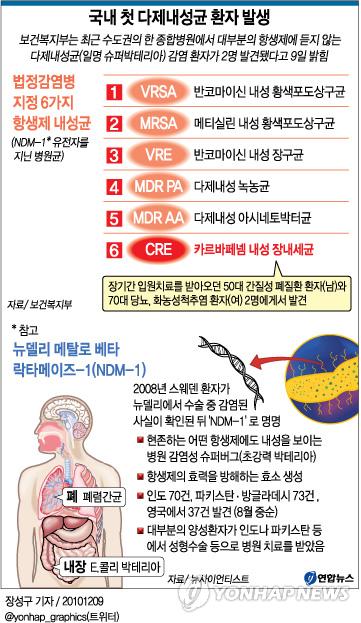
: Staphyloccus aureus 는 그람양성구균으로 이중 페니실린 항생제인 Methicillin 에 내성을 보이는 균을 MRSA( Methicillin-Resistant Staphyloccus aureus)라 부릅니다.
MRSA 감염발생시 다른 환자로부터 전파가 쉬워 집단감염으로의 발생 소지 가 많습니다.현재 치료제로 쓰이는 것은 Vancomycin이며, 이의 남용은 또다른 다 약제 내성균주의 출현을 초래할 수 있습니다.
전파경로
1) 접촉전파-MRSA균에 감염된 환자나 오염된 물체를 만진 후 손을 씻지 않거나 다른 환자와 접촉할 경우 전파되는 경우가 대부분입니다.
2) 공기전파-환자의 기침이나 인공호흡기의 호기 배출기 또는 상처 치료시 공기 중으로 전파될 수 있으나 확실하지는 않습니다.
관리지침
1) 손씻기-MRSA감염 또는 보균환자와 접촉후 일시적인 보균상태가 될 수 있습니 다. 손씻기는 전파를 차단하는 가장 중요한 방법으로 매 환자와 접촉한 후 반드시 손을 씻어야 합니다.
2) 장갑 - 감염의 우려가 있는 체액이나 물품과 접촉시 장갑을 착용해야 합니다. 같은 환자일 경우에도 다른 부위를 접촉하게 되면 장갑을 교환합니다.
3) 가운 - 체액이 튈 우려가 있다면 착용해야 합니다.
4) 마스크 - 호흡기 분비물에서 균이 분리되는 경우라면 출입시 마스크를 착용 합니다.
5) 의료물품은 환자 자신의 것을 준비합니다.그리고 다른 환자에게 사용하기 전에는 반드시 소독합니다.
6) 격리 - 호흡기 분비물에서 균이 배출된다면 1인실에 격리하는 것이 좋습니다.
기타 다른 부위에서 분리되는 경우에는 1인실까지는 아니나 같은 환자끼리 같은 장소에 집중관리 하는 것이 좋습니다.
Pan-resistant?? The rise of Acinetobacter
source: http://www.superbugtheblog.com/search/label/Acinetobacter
see also: The Fatal Menace of MRSA the SUPER BUG
see also: The Fatal Menace of MRSA the SUPER BUG
17 JUNE 2010
Pan-resistant?? The rise of Acinetobacter
This is an addition for archival purposes of a post that originally appeared at Scienceblogs.
A set of papers published this month in two journals provide an unsettling glimpse into the rocketing incidence and complex epidemiology of one really scary pathogen,Acinetobacter baumanii.
In the all-star annals of resistant bugs, A. baumanii is an underappreciated player. If people -- other than, you know, disease geeks -- recognize it, that is because it's become known in the past few years for its propensity to attack wounded veterans shipped to military hospitals from Iraq and Afghanistan, earning it the nickname "Iraqibacter." (Important note: Steve Silberman of Wired magazine took an early look at this phenomenon in 2007, in a great story that analyzed the epidemiology of Iraqibacter to show that military infection control, not the environment of Iraq, was to blame for the bug's rapid emergence.) A. baumanii is a nasty bug, causing not just wound infections but pneumonia, urinary tract infections, meningitis and bacteremia. Even more nasty, it collects resistance factors like baseball cards, and is commonly resistant to at least 4 antibiotic classes. The most resistant strains are susceptible only to the so-toxic-we-put-it-back-on-the-shelf-decades-ago antibiotic colistin.
This is a particular concern because A. baumanii is a Gram-negative bacterium -- and while the drug-development pipeline for Gram-positives such as MRSA has slowed practically to a trickle, the one for Gram-negatives has dripped itself dry. As the Infectious Diseases Society of America and Jerome Groopman of the New Yorker highlighted back in 2008, drugs for Gram-negatives are barely on the agenda for the few companies still conducting antibiotic development.
So, the first piece of bad news. In Infection Control and Hospital Epidemiology (ICHE), a team from Brooke Army Medical Center in San Antonio take a look at their incidence of resistant Ab and find it exploding. Between 2001 and 2008, the percentage of A. baumanii isolates that were resistant to at least 3 classes of drugs went from 4% to 55%; of all the isolates, 17% (127) were resistant to at least 4 drug classes, and one was resistant to, well, everything.
How does A. baumanii spread so fast? A second paper in ICHE suggests a reason: The bug seems to do a better job than other resistant pathogens of contaminating the gear and hands of health care workers. A study done at University of Maryland found that when health care workers took care of A. baumanii patients, they ended up with contaminated gowns and gloves 39% of the time, and with contaminated hands (after glove removal) 4.5% of the time. Those are higher rates than for MRSA (18.5% of encounters) or VRE (8.5%).
A review article in Clinical Infectious Diseases reminds us why we should care about this: It examines the drugs to which some strains of A. baumanii are still susceptible, and finds all of them significantly toxic to different organs (kidneys, liver, pancreas, red blood cells, ) at the doses necessary to wipe out the bug.
Which is all troubling by itself. But a paper and editorial also appearing in Clinical Infectious Diseases make the case for A. baumanii as a bigger threat than has been understood. The bug's recent epidemiology has shown a distinct split, between the highly resistant forms affecting veterans, most of them being treated in the military evacuation chain, and less-resistant forms affecting civilians in hospitals (including in the Brooks data in the paper above). The severe wounds, aggressive treatment and rapid multiple transfers of personnel in the military system inadvertently created an environment that not only put A. baumanii under great selective pressure, but also spread it with startling efficiency.
The paper, reporting data from 4 community hospitals near Detroit, shows that the civilian medical system -- that would be the one that most of us live in -- has duplicated that churning as well. Between 2003 and 2008, all A. baumanii in their network increased 25%. A. baumanii resistant to the first 2 front-line drugs went from 2% to 33% of isolates. And "pan-resistant" A. baumanii -- resistant to all 8 drugs available for it, an essentially untreatable strain -- went from nonexistent to 14% of all the isolates that network found.
The effect on the patients was dramatic, of course: The more resistant their strains were, the more likely they were to never go home from the hospital, but (if they did not die there) to be discharged instead to a nursing home, long-term acute care facility, or hospice. But the larger point is that they carried that multiply-resistant strain with them, distributing it throughout the region: Patients came to those 4 hospitals, carrying A. baumanii, from 17 different nursing homes; from the 4 hospitals, carrying A. baumanii, they were transferred out to 28 different nursing homes.
This is a smart analysis, and devastating in its implications. American hospitals do a debatable job right now of handling infection control -- but overwhelmingly, they are handling infection control as individual institutions, not as competitors in a local market, and certainly not as members of a geographic region. Yet this data demonstrates clearly that cooperation between hospitals and other healthcare institutions -- most of which don't have hospitals' infection-control budgets or personnel -- is going to be essential if we want to put the brakes on Acinetobacter before it soars in the civilian medical system in the same way it did in the military one.
A set of papers published this month in two journals provide an unsettling glimpse into the rocketing incidence and complex epidemiology of one really scary pathogen,Acinetobacter baumanii.
In the all-star annals of resistant bugs, A. baumanii is an underappreciated player. If people -- other than, you know, disease geeks -- recognize it, that is because it's become known in the past few years for its propensity to attack wounded veterans shipped to military hospitals from Iraq and Afghanistan, earning it the nickname "Iraqibacter." (Important note: Steve Silberman of Wired magazine took an early look at this phenomenon in 2007, in a great story that analyzed the epidemiology of Iraqibacter to show that military infection control, not the environment of Iraq, was to blame for the bug's rapid emergence.) A. baumanii is a nasty bug, causing not just wound infections but pneumonia, urinary tract infections, meningitis and bacteremia. Even more nasty, it collects resistance factors like baseball cards, and is commonly resistant to at least 4 antibiotic classes. The most resistant strains are susceptible only to the so-toxic-we-put-it-back-on-the-shelf-decades-ago antibiotic colistin.
This is a particular concern because A. baumanii is a Gram-negative bacterium -- and while the drug-development pipeline for Gram-positives such as MRSA has slowed practically to a trickle, the one for Gram-negatives has dripped itself dry. As the Infectious Diseases Society of America and Jerome Groopman of the New Yorker highlighted back in 2008, drugs for Gram-negatives are barely on the agenda for the few companies still conducting antibiotic development.
So, the first piece of bad news. In Infection Control and Hospital Epidemiology (ICHE), a team from Brooke Army Medical Center in San Antonio take a look at their incidence of resistant Ab and find it exploding. Between 2001 and 2008, the percentage of A. baumanii isolates that were resistant to at least 3 classes of drugs went from 4% to 55%; of all the isolates, 17% (127) were resistant to at least 4 drug classes, and one was resistant to, well, everything.
How does A. baumanii spread so fast? A second paper in ICHE suggests a reason: The bug seems to do a better job than other resistant pathogens of contaminating the gear and hands of health care workers. A study done at University of Maryland found that when health care workers took care of A. baumanii patients, they ended up with contaminated gowns and gloves 39% of the time, and with contaminated hands (after glove removal) 4.5% of the time. Those are higher rates than for MRSA (18.5% of encounters) or VRE (8.5%).
A review article in Clinical Infectious Diseases reminds us why we should care about this: It examines the drugs to which some strains of A. baumanii are still susceptible, and finds all of them significantly toxic to different organs (kidneys, liver, pancreas, red blood cells, ) at the doses necessary to wipe out the bug.
Which is all troubling by itself. But a paper and editorial also appearing in Clinical Infectious Diseases make the case for A. baumanii as a bigger threat than has been understood. The bug's recent epidemiology has shown a distinct split, between the highly resistant forms affecting veterans, most of them being treated in the military evacuation chain, and less-resistant forms affecting civilians in hospitals (including in the Brooks data in the paper above). The severe wounds, aggressive treatment and rapid multiple transfers of personnel in the military system inadvertently created an environment that not only put A. baumanii under great selective pressure, but also spread it with startling efficiency.
The paper, reporting data from 4 community hospitals near Detroit, shows that the civilian medical system -- that would be the one that most of us live in -- has duplicated that churning as well. Between 2003 and 2008, all A. baumanii in their network increased 25%. A. baumanii resistant to the first 2 front-line drugs went from 2% to 33% of isolates. And "pan-resistant" A. baumanii -- resistant to all 8 drugs available for it, an essentially untreatable strain -- went from nonexistent to 14% of all the isolates that network found.
The effect on the patients was dramatic, of course: The more resistant their strains were, the more likely they were to never go home from the hospital, but (if they did not die there) to be discharged instead to a nursing home, long-term acute care facility, or hospice. But the larger point is that they carried that multiply-resistant strain with them, distributing it throughout the region: Patients came to those 4 hospitals, carrying A. baumanii, from 17 different nursing homes; from the 4 hospitals, carrying A. baumanii, they were transferred out to 28 different nursing homes.
This is a smart analysis, and devastating in its implications. American hospitals do a debatable job right now of handling infection control -- but overwhelmingly, they are handling infection control as individual institutions, not as competitors in a local market, and certainly not as members of a geographic region. Yet this data demonstrates clearly that cooperation between hospitals and other healthcare institutions -- most of which don't have hospitals' infection-control budgets or personnel -- is going to be essential if we want to put the brakes on Acinetobacter before it soars in the civilian medical system in the same way it did in the military one.

05 FEBRUARY 2010
Bad news in the President's budget request
It's been a few days since the rollout of the White House's proposed 2011 budget request, time enough for people to dig deep into the minutiae and figure out what that massive document really says. The Infectious Diseases Society of America has done the drilling for the health and infectious disease line items, and I'm sorry to say the news is not good.
Worst first: The proposed budget would cut funding for the CDC's antimicrobial resistance programs by 50%, $8.6 million. That means that only 20 state or local health departments, or health care institutions, will get money from CDC for surveillance and control of resistant bugs. That's only 40% of what was funded this year, when 48 health departments and health systems were funded. Which is very disturbing: If there's one thing almost everyone agrees on with regard to MRSA, it's that we need moresurveillance, not less.
In addition, all state grants in the Get Smart About Antibiotics program, which runs campaigns to reduce inappropriate use, get zeroed out.
There are other cuts as well to infectious-disease program at CDC and elsewhere in HHS, including to to a major childhood immunization program and to pandemic defenses. And funding for HIV/AIDS, TB and other NIH research programs barely tiptoe upward.But these frank cuts in programs to combat antimicrobial resistance, at a time when MRSA is burgeoning, Gram negative organisms such as Acinetobacter are gaining ground, and drug development is stalling, surely cannot be smart.
The IDSA analyis is here.
Worst first: The proposed budget would cut funding for the CDC's antimicrobial resistance programs by 50%, $8.6 million. That means that only 20 state or local health departments, or health care institutions, will get money from CDC for surveillance and control of resistant bugs. That's only 40% of what was funded this year, when 48 health departments and health systems were funded. Which is very disturbing: If there's one thing almost everyone agrees on with regard to MRSA, it's that we need moresurveillance, not less.
In addition, all state grants in the Get Smart About Antibiotics program, which runs campaigns to reduce inappropriate use, get zeroed out.
There are other cuts as well to infectious-disease program at CDC and elsewhere in HHS, including to to a major childhood immunization program and to pandemic defenses. And funding for HIV/AIDS, TB and other NIH research programs barely tiptoe upward.But these frank cuts in programs to combat antimicrobial resistance, at a time when MRSA is burgeoning, Gram negative organisms such as Acinetobacter are gaining ground, and drug development is stalling, surely cannot be smart.
The IDSA analyis is here.
29 DECEMBER 2009
Another resistant bug rising: Acinetobacter
From the excellent and forward-thinking research team at Extending the Cure comes a dismaying report: over 7 years, a more than 3-fold increase in resistance in the Gram-negative bacterium Acinetobacter baumanii to its drug of last resort, imipenem.
Because MRSA is a Gram-positive, we don't talk much here about the Gram-negatives — the two categories of bacteria have different cell-wall structures and thus are treated using different categories of drugs. (That structural difference causes them to react in different ways to a stain invented by a scientist named Gram in the 19th century.) But the resistance situation with Gram-negatives is at least as dire as with MRSA, possible more so, because there are fewer new drugs for Gram-negatives in the pharmacology pipeline (as discussed in a New Yorker article by Dr. Jerome Groopman last year.)
And Acinetobacter is one nasty bug, as science journalist Steve Silberman ably documented in Wired in 2007 when he traced the spread of the organism through the military medical-evacuation chain from Iraq, demonstrating that the vast increase in resistant Acinetobacter among US forces was due to our own poor infection control.
The Extending the Cure paper (which will be published in February in Infection Control and Hospital Epidemiology) puts hard numbers to the Acinetobacter problem. Drawing on data from the private Surveillance Network, which gathers real-time electronic results from 300 US hospitals, they find:
Our results demonstrate substantial national and regional increases in carbapenem resistance among clinical isolates of Acinetobacter species over the period 1999–2006. Increasing carbapenem resistance among Acinetobacter species is particularly troubling, because it is very often associated with multidrug resistance and because it is occurring in the context of increases in the incidence of Acinetobacter infection.
There's a further point to be made that is not explicit in the paper that I can see (though it is often made by Extending the Cure researchers). Acinetobacter needs attention, just as MRSA does — but if we focus just on the individual organisms, we are not going far enough. Antibiotic resistance is a system problem: It is an issue of infection control, of drug development, of agricultural organization, of federal priorities. It needs sustained attention and comprehensive, thoughtful, wide-ranging response. Now would not be too soon.
Because MRSA is a Gram-positive, we don't talk much here about the Gram-negatives — the two categories of bacteria have different cell-wall structures and thus are treated using different categories of drugs. (That structural difference causes them to react in different ways to a stain invented by a scientist named Gram in the 19th century.) But the resistance situation with Gram-negatives is at least as dire as with MRSA, possible more so, because there are fewer new drugs for Gram-negatives in the pharmacology pipeline (as discussed in a New Yorker article by Dr. Jerome Groopman last year.)
And Acinetobacter is one nasty bug, as science journalist Steve Silberman ably documented in Wired in 2007 when he traced the spread of the organism through the military medical-evacuation chain from Iraq, demonstrating that the vast increase in resistant Acinetobacter among US forces was due to our own poor infection control.
The Extending the Cure paper (which will be published in February in Infection Control and Hospital Epidemiology) puts hard numbers to the Acinetobacter problem. Drawing on data from the private Surveillance Network, which gathers real-time electronic results from 300 US hospitals, they find:
- full resistance to imipenem rose from 4.5% of isolates in 1999 to 18.2% in 2006 — a 300% increase
- intermediate resistance rose from 1.3% of isolates to 9.4 — a 623% increase
- susceptible isolates declined from 94.1% to 72.4% — a 23% decrease.
Our results demonstrate substantial national and regional increases in carbapenem resistance among clinical isolates of Acinetobacter species over the period 1999–2006. Increasing carbapenem resistance among Acinetobacter species is particularly troubling, because it is very often associated with multidrug resistance and because it is occurring in the context of increases in the incidence of Acinetobacter infection.
There's a further point to be made that is not explicit in the paper that I can see (though it is often made by Extending the Cure researchers). Acinetobacter needs attention, just as MRSA does — but if we focus just on the individual organisms, we are not going far enough. Antibiotic resistance is a system problem: It is an issue of infection control, of drug development, of agricultural organization, of federal priorities. It needs sustained attention and comprehensive, thoughtful, wide-ranging response. Now would not be too soon.
Subscribe to: Posts (Atom)
Monday, March 11, 2013
The End of Antibiotics?
업로드된 날짜: 2010. 09. 29.
Antibiotics are the one single medical discovery to save more lives than any other. Today, sixty years after the start of their widespread use, we face a potential future without them. As more and more bacteria become resistant to current antibiotics, very few new antibiotics are approved for use, or even developed by pharmaceutical drug companies. What does the future hold? Will doctors be able to perform simple surgeries without the necessary infection preventions on hand? Can incentives be given to induce more research and development in this area? What should government be doing to avoid this catastrophic scenario?
카테고리
라이선스
표준 YouTube 라이센스
Super Bugs -- Bacterial Drug Resistance
업로드된 날짜: 2008. 07. 3.
We are under attack — by germs. Drug-resistant bacteria are invading organisms, and hospitals are their favorite breeding ground. Scientists are studying the genetics of bacteria and trying to find out how to stop the invasion.
All 50 Secrets of the Sequence videos have an accompanying classroom-tested lesson that encourages students to further explore the video topics. Each lesson includes background information, state and national science standards, discussion questions and answers, teacher notes and an activity that will ensure a hands-on, "minds-on" experience. To see lessons for this series, visit http://www.pubinfo.vcu.edu/secretsoft....
All 50 Secrets of the Sequence videos have an accompanying classroom-tested lesson that encourages students to further explore the video topics. Each lesson includes background information, state and national science standards, discussion questions and answers, teacher notes and an activity that will ensure a hands-on, "minds-on" experience. To see lessons for this series, visit http://www.pubinfo.vcu.edu/secretsoft....
카테고리
라이선스
표준 YouTube 라이센스
[VRE]VRE 란?
source: http://blog.daum.net/ansan-icu/409
VRE
VRE(Vancomycin Resistant Enterococcus)란?
장구균은 정상적으로 장관, 여성의 질 부위에서 발견할 수 있는 유기체로, 반코마이신이 이균을 사멸시킬 수 없을 때 VRE라 부릅니다.
VRE는 요도계, 장관계, 호흡기계, 피부 등에 집락할 수 있고, 요도계, 호흡기계, 수술부위, 혈액에서는 감염의 원인이 될 수 있습니다.
VRE는 치료약제로 이용할만한 항균제가 적고, VRE의 반코마이신 내성 유전자가 황색포도구균 등의 다른 그람양성균으로 전달될 수 있다(VRSA, VRSE등)는 점에서 문제가 큽니다.
VRE는 그 내구력이 매우 강하여 딱딱한 표면에는 7-10일, 손에서 몇 시간 생존이 가능합니다.
그러나 손씻기와 소독제의 적절한 사용으로 쉽게 사멸시킬 수 있습니다.
따라서 VRE 균 집락 또는 감염인 경우, 전파를 방지하기 위해서는 접촉격리를 반드시 해야 합니다.
VRE는 간단히 말해서 vancomycin에 내성이 있어서 그렇게 이름이 지어졌습니다.
이것이 왜 생기냐 하면은, 병원에 오시면 항생제를 굉장히 많이 사용합니다.
대부분의 환자들이 항생제를 사용하고 있지요.
제일 처음에 쓰는 것이 베타-lactam계 항생제(cefe계, cillin계, imipenem, Azactam)를 사용합니다.
그 항생제를 오래써서 내성이 생기면 MRSA구요, MRSA를 치료할려고 저렴한 vancomycin을 계속 사용하다본 거기에도 내성이 생겨 VRE가 되는 것입니다.
즉, 장기간 항생제를 투여한 사람들에게 생기는 것입니다.
윗 글에서도 나와 있듯이 Enterococcus는 장내상주균 입니다.
상주균 이기 때문에 면역력이 떨어진 다른 환자들을 보호하기 위해 격리를 시키는 것입니다.
또한 VRE는 장이나 직장쪽에서 검출이 되어 발겨이 된다면 원래 상주균이기 때문에 비보험이라 치료에 돈이 많이 들지만, 혈관에서 발견되었다고 하면 보험이 된다고 합니다.
VRE 치료?
가장 좋은 방법은 항생제를 중단하는 것이 제일 입니다.
그리고 VRE라고 판명된 즉시 격리조치를 취합니다.
치료약은 사람에 따라 매우 다르기 때문에 sensitive한 약을 사용하고 최대한 빨리 끊는 것이 최선입니다.
VRE 해제?
주 1회에 미생물 배양검사를 나갑니다.
3주 연속으로 resensitive하여야 vRE가 해제가 됩니다.
Skin test는 베타-lcatam계만 한다고 합니다~ Azactam만 빼고말이죠~
베타-lactam계가 아닌 항생제는 Skin test없이 사용한다고 합니다~
Subscribe to:
Comments (Atom)